Lullabet
For people who sell on Etsy, Amazon KDP and print-on-demand
Type a child's name.
Pick a world. Rewrite any page.
Get a print-ready book nobody
else who buys this can publish.
Two print-ready PDFs, about a minute apart
Thirteen two-page spreads in that child's letters, in your pick of four illustrated worlds — one of them a whole second alphabet of characters. Every page flips between a lullaby verse and a dream verse, or takes your own words. It closes with a poem spelled from the name — and the book is seeded to your account, so the buyer who reads this page after you cannot produce the same file.
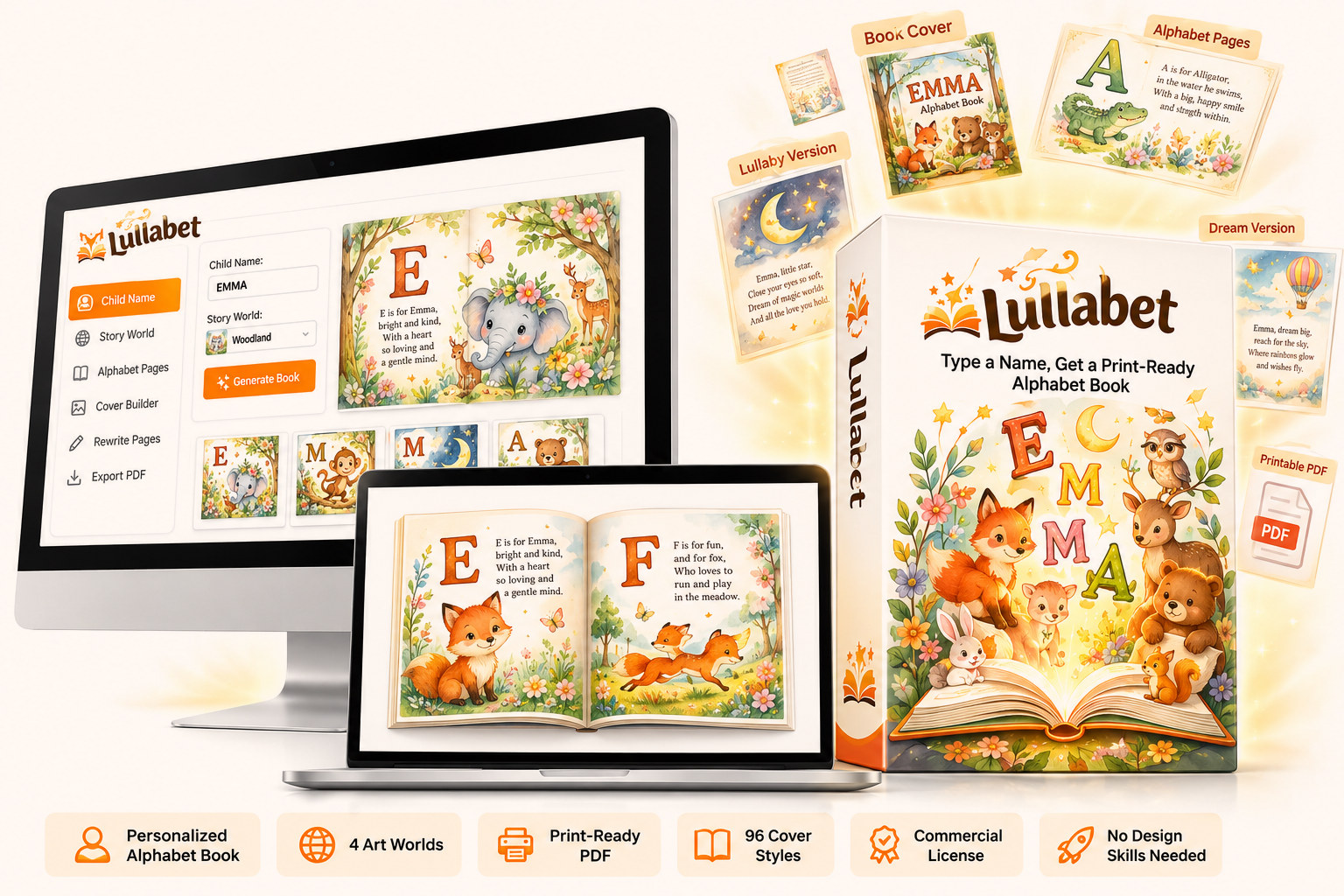
$9.95 one time · no subscription
Instant access · 30-day refund · commercial licence included
That is a picture. This is the real thing — type a name and watch the cover build:
The book has the child’s name printed through it.
Not written on a label. Not filled into a blank. Printed, on every spread.
M is for Mouse because the child is called Mia. The next spread is I, then A, because that is how her name is spelled.
Search “personalised alphabet book” on Etsy or Amazon and you will find shops doing nothing else. Some have been doing nothing else for years.
Here is why that category behaves differently from everything else you have tried to sell.
The person buying is almost never the person reading. It is a grandmother, an aunt, a godparent, a friend who has been invited to a first birthday and has four days to find something.
They are not shopping. They have already decided to buy. They are looking for the thing that will not embarrass them.
And a book with the child’s name in it cannot be compared against anything, because there is no second one. There is no cheaper Emma book on page two.
It also does not come back. Nobody returns a gift with a child’s name printed thirteen times inside it.
Which is why the prices in this category look the way they do. A journal or a planner lives under ten dollars because the buyer is choosing between ten thousand of them. A personalised name book does not have that problem, and the listings show it.
You are not selling a book. You are selling the thing somebody hands over at a first birthday, and that is a different transaction with a different ceiling.
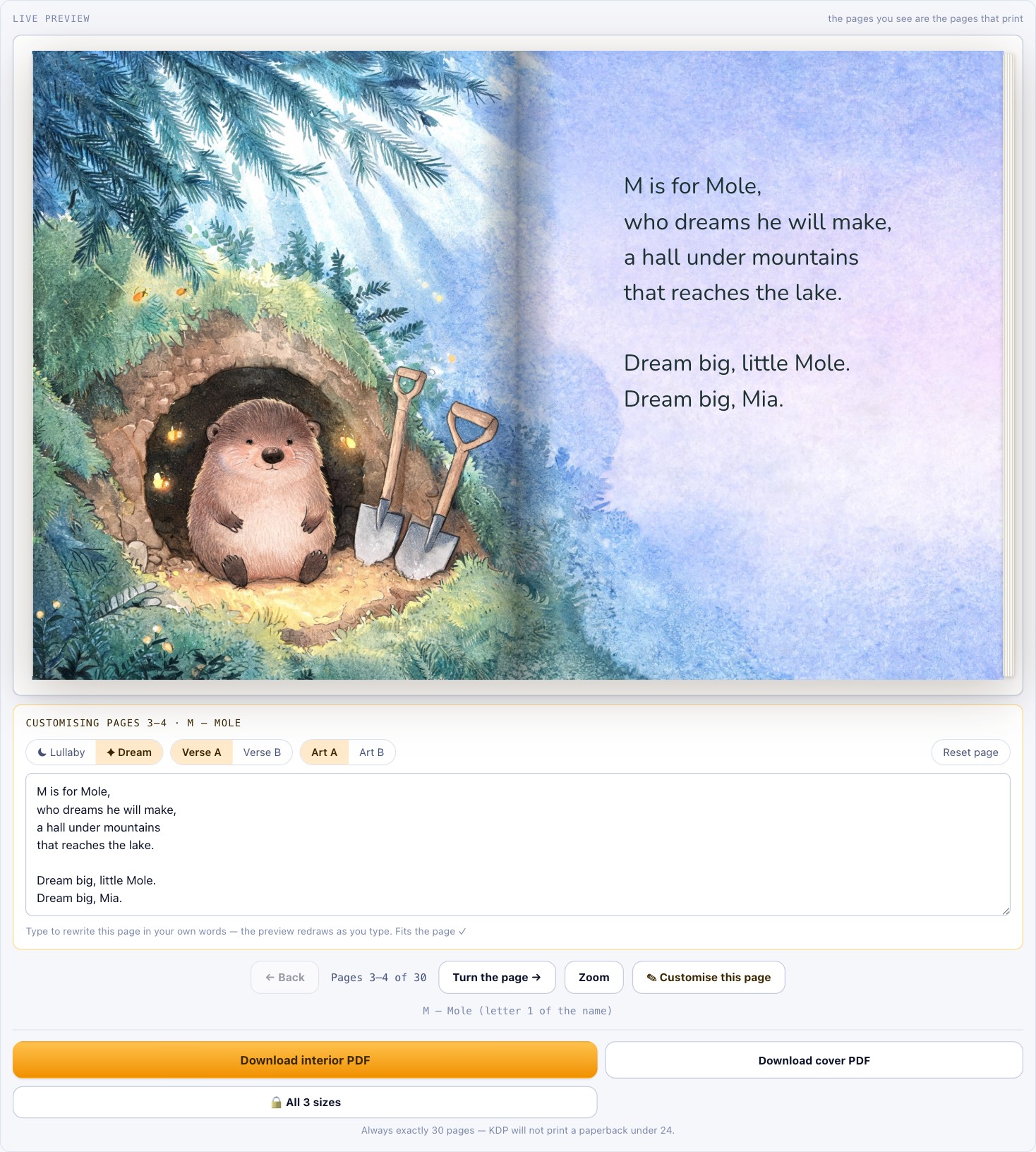
This is a whole spread. Nothing is trimmed.
Every letter of the name gets one of these, printed across two full pages with the illustration running under it edge to edge.
Spread 1 of 13 — the book for a child called Mia
Six lines, the same shape every time, and the last line is always the child’s name.
A parent reading it aloud hits that name thirteen times before the book closes.
There are two verses for every letter, not one.
Elizabeth has two E’s. Anna has two A’s and two N’s. With one verse per letter the book repeats a page — and that is the first thing a buyer notices and the last thing they forgive.
All 52 were written for this book. Verses from an Etsy shop are that shop’s copyright, and we did not need to borrow any.
Every book picks a world. One of them changes the whole alphabet.
These four pictures are the same letter M, taken straight from the product. Same name, same seed — a different universe per card.

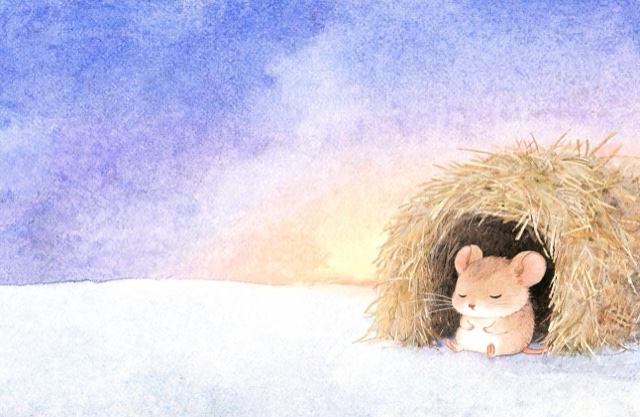
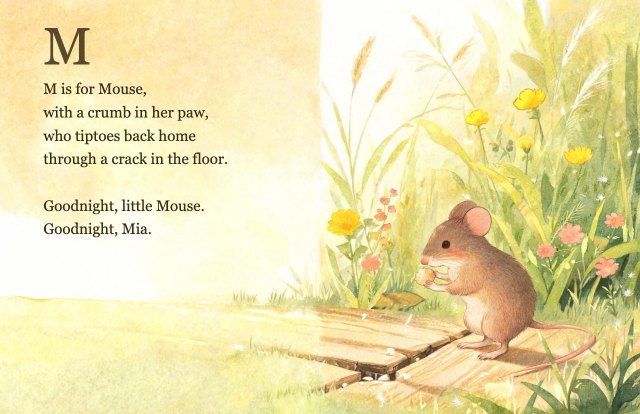
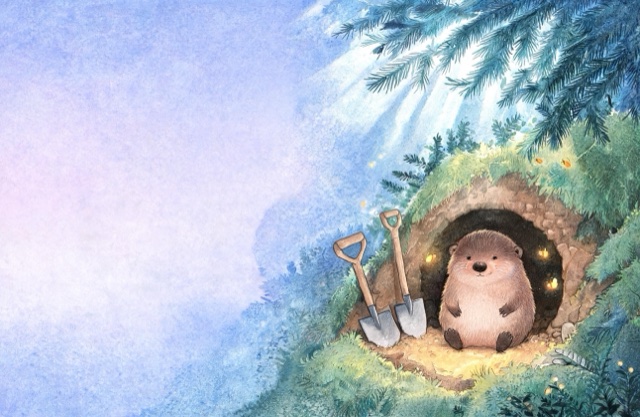
The first three dress the same twenty-six animals in different art. Woodland goes further: new characters for every letter — Mole for M, Nightingale for N, a desert squirrel visiting the forest for X — with a hundred and four verses written just for it. Pick a world per book: one name can become two completely different listings.
The last pack you bought gave every buyer the same files.
Including yours.
That is how a vault works. That is how PLR works.
One set of files, sold to everyone who clicks. The person who bought it at 9am is competing with the person who bought it at 9:04.
You already know how that ends, because you have watched it happen.
The listing does fine for a few weeks. Then the same product appears under four other shop names. Then eleven. Then the price starts sliding, and whoever is willing to make the least money wins.
And the worst part is that you did nothing wrong. You bought a good product. So did four hundred other people, on the same afternoon, from the same email.
Lullabet is built so that cannot happen to you.
Your account is mixed into how the book is assembled — the padding letters, the pairing of verse and picture, the cover.
Two people who both type “Emma” get two different books. Not two versions of the same book. Two different books.
Type the same name twice yourself and you get the identical file back, so a reprint always matches what you sold.
Everyone works it out eventually. Then they hit the same wall.
The maths of this niche is not hard. Anyone who looks at it for ten minutes sees the opportunity. The problem has never been seeing it.
Here are the four roads in, and where each one stops.
-
Road one
Hire an illustrator
This produces the best book. It also produces one book. Thirteen spreads is weeks of someone else’s time, and you pay for it before you know whether the name sells.
Then the next name needs thirteen more. The cost does not go down with the second book, or the twentieth. You are not building an asset; you are commissioning one painting at a time.
-
Road two
Build it yourself in Canva
Free, and it works — the first time. You lay out 30 pages, you place the text, you fix the bleed, you export, KDP rejects it, you fix the spine, you export again.
Now do it for the next name. Every letter is a different animal, so it is not one text box you retype; it is thirteen different spreads rebuilt.
This is the road most people take, and it is the one that quietly ends after the fourth book. Not because it failed. Because they worked out what they were paying themselves an hour.
-
Road three
Buy a template pack or a PLR vault
Fast, cheap, and it hands you finished files. It also hands the identical finished files to everyone else who bought it, and they are all uploading this week too.
You are not competing with the market any more. You are competing with everyone who clicked the same button you did, on a product where the only lever left is price.
-
Road four
Use an AI image generator
The pictures come out beautiful. Then you need twenty-six of them that look like they belong in the same book, which is a completely different problem, and one that eats a weekend before it eats a month.
Style drifts. The bear is photographic and the cat is a cartoon. The lighting changes direction. Half the images are the wrong shape for a two-page spread, and the ones that fit are 1,024 pixels wide when a printer wants 5,175.
Then you still have to typeset the thing, and you are back on road two.
Every one of those roads is somebody trying to produce a book. That is the wall. A book is a big thing to produce, and you have to produce a new one for every name you want to sell.
Low-content books stopped working. This is not a better low-content book.
A journal, a planner, a maze book. The buyer is buying it for themselves, they are choosing on price, and there are ten thousand near-identical ones to choose from.
That race has a floor, and everybody has already found it.
A book with a child’s name printed through it is a different animal:
A low-content book
- Bought for yourself
- Chosen on price
- Compared against thousands
- Category price: under $10
A personalised name book
- Bought as a gift
- Chosen on the name
- Nothing to compare it against
- Category price: $32–43
Those are the paperback prices this category lists at — market observation, not a forecast. Nothing here says what you will sell. See the earnings disclaimer.
Nobody price-compares a book with their granddaughter’s name on the cover, because there is nothing to compare it to.
The competition for the “Emma” book is the next name on your own list.
So the catch was never the market. It was the making.
One name is one book is one listing. So you either pay an illustrator — real money, weeks per title — or you drag a text box across 30 pages in Canva and then do the whole thing again for the next name.
Most people make three or four, work out the hourly rate, and stop.
The book does not need to be drawn for each name.
It only needs to be assembled.
The animals, the verses and the layout stay put; the name decides which of them appear and in what order. That is why a book takes a minute instead of a week.
One payment. 30-day refund. Commercial licence included.
A book is a big thing to make. A book is a small thing to assemble.
Here is the whole trick, and it took a while to see it.
Nothing in an alphabet book actually depends on the name except which letters appear, and in what order.
The mouse does not change because the child is called Mia. The verse about the mouse does not change. The layout does not change.
So none of those things need making twice.
What sits underneath every book is the same fixed set:
52 characters
Two full alphabets of them — the classic animals, and Woodland’s own cast — each world drawn to a single style so thirteen spreads read as one book.
208 verses
Two per letter, in two tones — lullaby and dream — in each world. Same seven-line shape every time, last line always the name.
One fixed geometry
Trim, bleed, text box, spine. Solved once, correct for every name that comes after.
Type a name and the software walks its letters, pulls the matching character and verse for each one, and lays them out. That is the book — and then everything it chose, you can override: flip the tone, swap the picture, recast a spread, or write the page yourself.
Two details in there are worth more than they look.
Why two verses per letter, not one. Elizabeth has two E’s. Anna has two A’s and two N’s. With one verse per letter, those books repeat a page — and a repeated page is the first thing a buyer notices and the last thing they forgive.
Why every book is 30 pages. KDP will not print a paperback under 24. “Bo” is two letters, which would be a six-page file no printer will take. So short names are padded out to thirteen spreads with letters chosen to read like the end of a bedtime story rather than filler.
Neither of those is a feature anyone asks for. Both are the difference between a file that sells and a file that gets returned.
How it works
-
Step 01
Type the child’s name
Every letter becomes a two-page spread, in her order — M for Mouse, I for Iguana, A for Alligator. Spaces, hyphens and apostrophes are kept, so Anne-Marie and O’Brien print correctly.
-
Step 02
Pick the look
Illustration style, typeface, book size, cover colour, cover wording, cover layout, and a dedication line if you want one. The preview redraws as you choose — including the cover.
-
Step 03
Download two PDFs
The interior and the one-piece wrap cover. Print resolution, full bleed, spine already calculated from the page count. Nothing to fix, nothing to resize, nothing to open in another program first.
-
Step 04
Upload, then do the next name
Straight to KDP as they are. Then type the next name. That is the whole loop, and it is about a minute long.
Open any page and make it yours.
Every page carries two verses on tap — a lullaby that tucks the animal in, and a dream about what it could be. The two best-selling angles in this niche are “goodnight” books and “you can be anything” books. Here they are a toggle, per page: an all-lullaby book for a newborn, an all-dream book for a school starter, or your own mix.
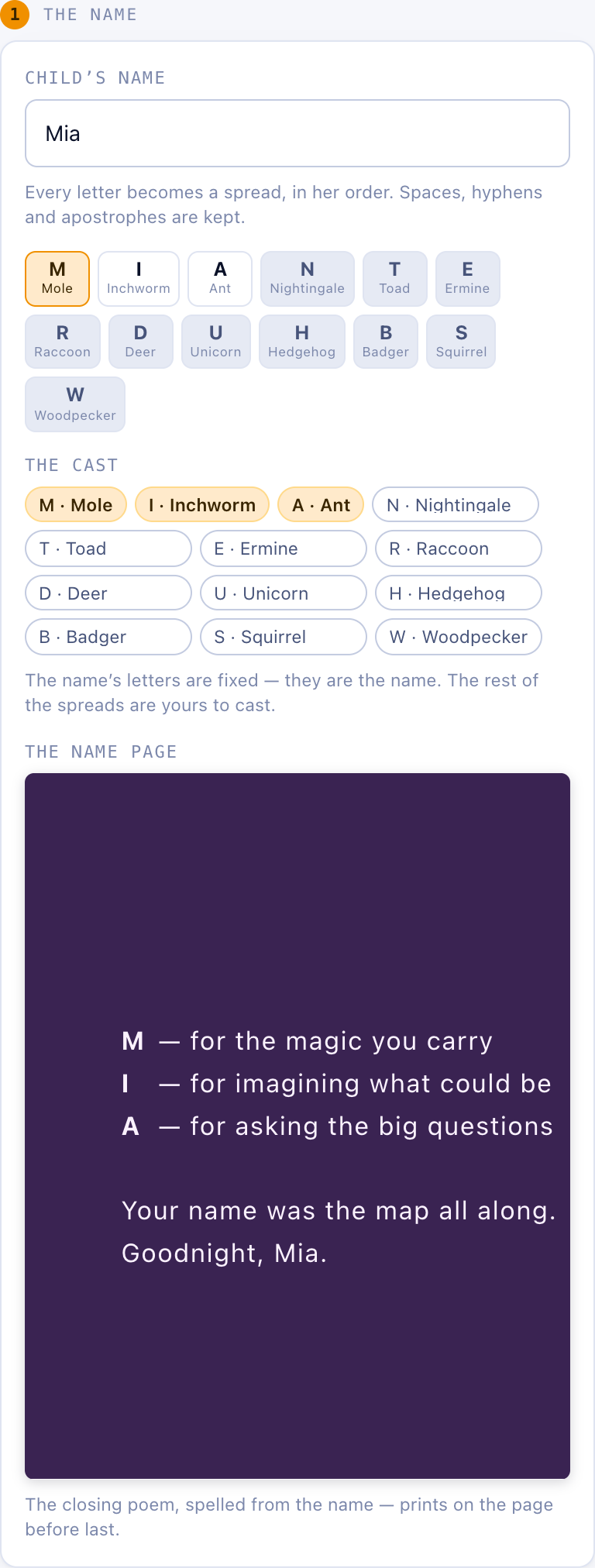
It ends with the name itself
The page before last is a short poem spelled down the child’s name — M for the magic you carry, I for imagining what could be, A for asking the big questions — closing with “Your name was the map all along.”
It is the page people photograph. Every line of it can be rewritten in the same editor, like any other page.
Ten names, one sitting, and nothing left to fix.
Here is the part that is hard to picture until you have done it once.
You open a list of names. Not a niche list — just names.
Emma. Noah. Olivia. Liam. Ava. Sophia. Mia. Lucas. Isla. Leo.
You type the first one. The book appears while you are still reading the cover.
You pick a colourway you like, choose which spread goes on the front, and add a dedication line if you feel like it. Two files download.
You type the second name.
Nothing carries over from the first book except the parts that should. The layout is already right. The bleed is already right. The spine has already been recalculated for a book that is, again, exactly 30 pages.
Then the third. Then you stop checking the cover so carefully, because it keeps coming out right.
By the time the tea is cold you have ten books.
Not ten drafts. Not ten things to fix in Canva later. Ten interiors and ten covers, at print resolution, that you can upload as they are.
What happens after you upload is your business, your niche and your covers, and this page is not going to pretend otherwise. See the earnings disclaimer.
One name. Two shops. One sitting.
Most products you buy feed one shop. This one feeds two, and not by accident.
Every book leaves the studio twice, and the two are not the same file.
The print edition is heavy on purpose: 13 full-bleed pictures at full resolution, 28 to 81 MB depending on the world. The Etsy-sized copy is the same book — same pages, same verses, same cover — with the pictures brought down to screen resolution. That one is 2 to 10 MB.
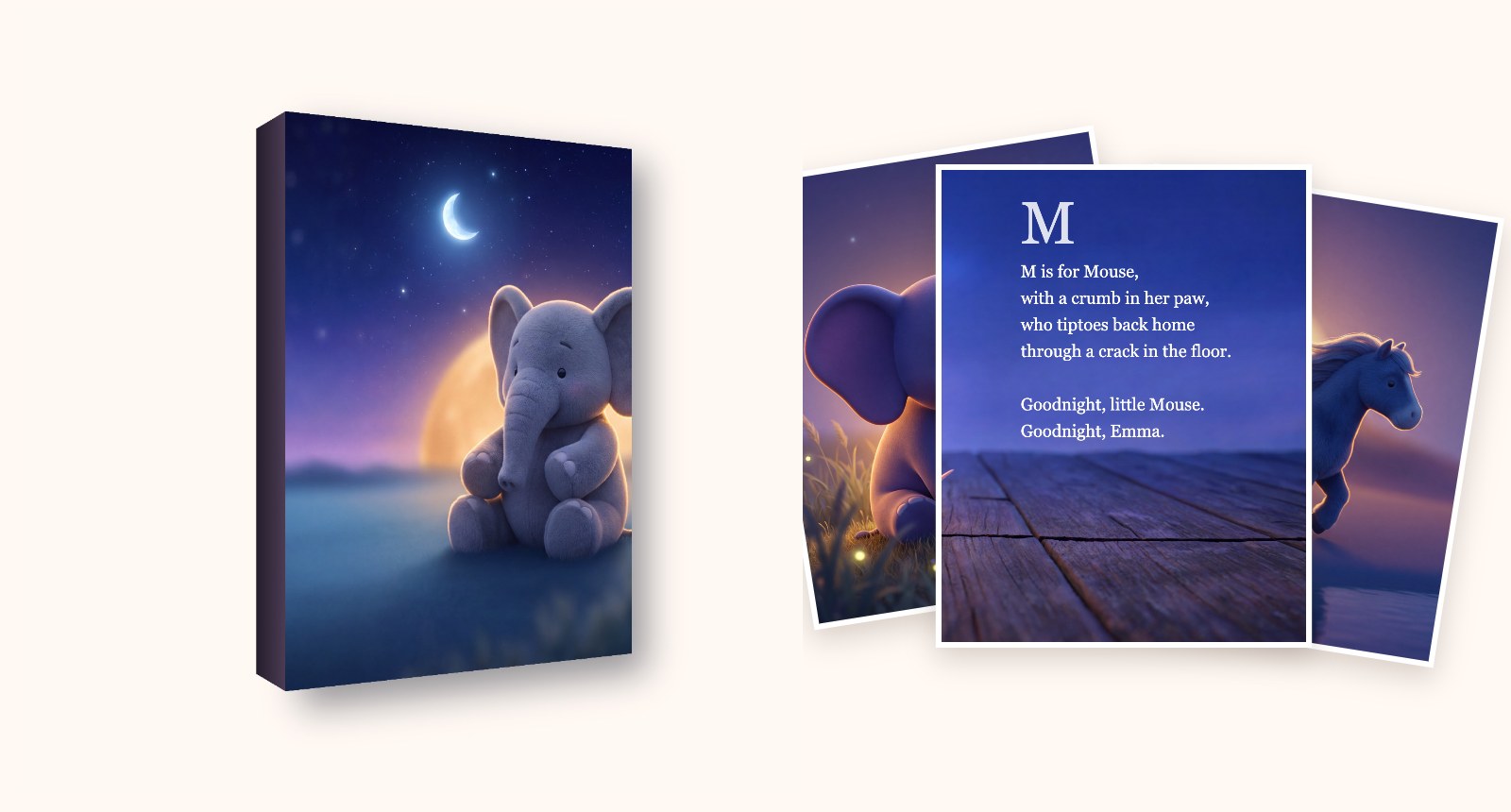
Etsy-sized copy → Etsy
- 2.3–10.1 MB for the book and cover together
- Etsy caps instant downloads at 20 MB — this clears it in every world
- Sells as a digital download the buyer prints at home
- 139 DPI: made for home printers and screens, not a print shop
Print edition → KDP
- 28–81 MB depending on the world — 13 full-bleed illustrations
- KDP’s limit is 650 MB
- Sells as a printed paperback
Same name, one sitting, two listings on two platforms. We measured both numbers in the browser rather than estimating them, which is why they are odd numbers instead of round ones.
The two do not compete with each other. Somebody buying an instant download at midnight because the party is on Saturday is not the same person ordering a printed paperback a fortnight ahead.
One name, two buyers, two price points, two platforms — and the second listing costs you nothing beyond the upload, because the file was already sitting in the folder when you made the first one.
One payment. 30-day refund. Commercial licence included.
What it does not do
- It does not sell the books. No traffic, no listings, no marketing. It makes the files; getting them in front of buyers is your job.
- It makes one book at a time. Type a name, get a book. If you want to feed it a list of two hundred names and walk away, that is a separate upgrade, not this.
- English only, and one book size at this level — 8.5 × 11 in.
- The illustrations are AI-generated. We made them once and licensed them to you inside the books. You may sell the books; you may not sell the pictures on their own or as a pack.
- We cannot promise any marketplace will accept anything. Amazon and Etsy set their own rules and change them without telling us. What we can promise is the specification the files are built to, and it is written on this page.
- It will not tell you which names to make. There is a starter list inside, but choosing what to publish is research, and research is a different job from production.
- It does not write your listing. Title, keywords, description and mockups are yours to do — or a separate upgrade, and you will be shown it after you buy rather than now.
The pictures are AI-generated. Here is exactly what that means.
It means we generated them. Once. Before you ever saw this page.
Each illustrated world was made to its own fixed brief so its characters sit in one style, then checked picture by picture — and where a scene came out wrong, regenerated — then cut to shape and packed into the product.
What it does not mean:
There is no AI running when you use this. No prompt box, no credits, no API key, no queue, no monthly bill, no failed generation at 11pm because a service went down.
You are not paying for access to a generator. You are buying a finished set of pictures and the software that arranges them.
Two things follow from that, and both are in your favour.
A book costs you nothing to make. Not a credit, not a cent. The tenth book costs what the first one did.
And the style cannot drift, because nobody is generating anything any more. The bear and the cat were made in the same session, to the same brief, and they will still match each other in a year.
Amazon asks publishers to declare AI-generated content when they upload. Declare it — it is a checkbox, not a problem, and thousands of books on the store carry it.
What actually comes out
Screenshots and files only. No testimonials until real buyers have written them, and no income claims at all.
| Pages | Exactly 30, every time |
|---|---|
| Spreads | 13, each a full two-page illustration |
| Interior | PDF, 300 DPI, full bleed |
| Cover | One-piece wrap PDF — back, spine, front — spine from page count |
| Trim | 8.5 × 11 in |
| Worlds | 4, all fully illustrated — one with its own cast |
| Editing | Any page: tone, verse, art, or your own words — saved to your account |
| Etsy copy | Same book at 139 DPI — 2.3–10.1 MB, under Etsy’s 20 MB download cap |
| Time | About a minute from typing the name to both files |
Thirty pages is not a round number we liked. KDP will not print a paperback under 24 pages, and short names would otherwise produce a six-page file that no printer will take. So the book pads to 13 spreads whether the name is “Bo” or “Alexandria”.
What you actually own at the end of this.
“Commercial licence” is written on so many products in this market that it has stopped meaning anything. So here it is spelled out.
You may
- Sell the books you make. Print or digital.
- Sell them on Amazon KDP, Etsy, your own shop, or anywhere else.
- Publish under your own name or imprint. Ours appears nowhere.
- Keep every penny. No royalty, no revenue share, no reporting.
- Make as many as you like, for as many names as you like, forever.
You may not
- Resell or share the software itself.
- Sell the illustrations on their own, as a pack, or as stock art.
- Share your account. One purchase is one person.
That is the whole of it, and it is the same at $9.95 as it would be at $99. The upgrades behind this page make the work faster and wider. None of them sells you the right to sell. You get that here.
The binding version is on the terms page, and it says the same thing in longer sentences.
What you get
The book builder
Unlimited books, unlimited names, for as long as the product runs. No per-book charge and no counter.
Four worlds, 52 characters
Moonlit Meadow, Watercolor, Wildflower — and Woodland, a second alphabet with its own cast for every letter.
208 verses in two tones
Every page flips between a lullaby and a dream — or takes your own words, which print exactly as typed.
96 cover combinations
Four colours, four ways to word the title, two layouts, three back-cover blurbs — in every world. You pick, or let the book choose.
The Name Page
A closing poem spelled down the child’s name, ending “Your name was the map all along.” Rewritable like every page.
A different book per buyer
Two people who both make a book for “Emma” do not get the same file. Nobody else can publish yours.
Commercial licence
Publish and sell what you make, under your own name or imprint, with no royalty and no further fee.
Why $9.95 and not $97?
Because I would rather have you as a customer than have your $97 today. There are upgrades behind this page and you will see them after you buy.
You do not need any of them. The licence you get here is the whole licence: make as many books as you like, for as many names as you like, and sell every one of them. The upgrades make it faster and wider. They do not unlock the right to sell.
I would rather tell you that here than have you find it out at the checkout and feel handled. Everyone on this platform has been handled before, including me.
$9.95 one time
Get Lullabet — $9.95your mind
Keep reading if you would rather be sure first.
“So what stops this getting saturated too?”
Fair. It is the question I would ask.
Three answers, and the first two are honest about what they do not cover.
One. Your books are not the same as other buyers’ books. That is the account seeding, and it is real — there are two covers for the same name further up this page proving it. But it does not stop other people selling name books. It stops them selling yours.
Two. The category does not saturate the way a product does. A planner competes with every other planner. A book called “Emma” competes with other books called “Emma” — and there are only so many people making one this week.
The supply of names is not a niche you can flood. It is a list that renews itself every year, in every country, forever.
Three. Most people will not do it anyway. This is the uncomfortable one and it is also the true one. Making files is the easy half. Listing them, writing the titles, getting the keywords right, staying with it past the third week — that is where the field thins out, and no tool on earth fixes it.
If you were hoping the answer was “nothing can go wrong”, that is not an answer I have.
Is this for you?
Yes, if
- You publish on KDP or Etsy already, or you are willing to learn how to upload a PDF.
- You want to list many names rather than one perfect book.
- You want to own what you make and sell it under your own imprint.
- You would rather have a finished file than a template to fight with.
- You have a shop already and you want a line to add to it, not a business to start.
- You are willing to do the listing work, which is the half no software does.
No, if
- You want a business that runs itself. This makes files. Nothing else.
- You want to sell the illustrations as art, as a pack, or as stock.
- You need a language other than English.
- You want to draw every page yourself — you will find this far too fixed.
- You are hoping the tool will bring you buyers. It will not.
- You want to rewrite the verses or swap the animals. You cannot; that is the trade for the speed.
- You are buying it to resell the software or the pictures. Read the terms first.
Questions
Do I need Photoshop, InDesign or Canva?
Do I need an AI subscription or an API key?
Two people make a book for the same name. Do they get the same book?
Can I really sell what I make?
Is this a monthly fee?
Will Amazon accept the files?
What does the free version do?
How many books can I make?
I have never uploaded anything to KDP. Can I still use this?
What if the name has an accent, a hyphen or an apostrophe?
How long can a name be?
Are the illustrations the same in every book?
Can I edit the verses or swap a character?
Do I need to credit you anywhere?
What happens if I forget which cover I used for a book I already sold?
Is there a time limit or a licence renewal?
What exactly is a “world”?
If I rewrite a page, what happens to my words?
Do the lullaby and dream verses cost extra?
What do you get out of selling this for $9.95?
Refunds
30 days. Buy it, make a book, and if it is not what you expected, email leo@leosterling.net within 30 days and you will get your money back. You do not have to explain yourself. The full policy is on the refunds page.
Lullabet is a tool that makes files. Nothing on this page states or implies how much money you might make, because we have no idea — that depends on your niche, your covers, your listings and your marketplace, none of which are in this software. See the earnings disclaimer.
P.S.
You do not have to take my word for any of this, and you do not have to spend anything to check.
The free version builds the entire book. Every spread, every verse, the cover, the lot. It just stamps the pages so you cannot sell what comes out. Go and make one for a name you actually know. Read all 13 spreads. Look at the cover. Then decide whether $9.95 is worth it to take the stamp off and get the licence.
That is the whole pitch. If the book is no good you will know in four minutes, and it will have cost you nothing.
And if it is good, the stamp is the only thing between you and a file you can list tonight.
P.P.S.
One more thing, because it is the part people work out too late.
The names do not run out. Every year a new set of children is born into every English-speaking country, and every one of them has a first birthday, a christening, a first Christmas, a grandmother who has left it too late.
A planner niche dies when enough people find it. A list of names does not die. It just gets longer.
Whether you do anything with that is not something I can promise or predict, and this page has been careful all the way down not to pretend otherwise. What I can tell you is what the $9.95 buys: the software, the four worlds, the 208 verses, the clean export, and the licence to sell every book you make with them.
The rest is the part nobody can do for you.
30-day refund. One payment. Commercial licence included.